Santa Catarina Island, where most of the city of Florianópolis is located, offers much more than just the natural beauty that visitors seek.
The island was once a hereditary captaincy and its architecture bears the legacy of the Portuguese who landed here mainly between the 16th and 18th centuries.
During the colonial period, Church and Monarchy went hand in hand, and therefore, the Portuguese began each settlement by building chapels that represented the union between State and religion, and from which the new settlement would be instructed in the precepts of faith and government.
As the settlement grew, its church increased in size and received a new name, demonstrating its hierarchy before the Crown.
One way to go back in time and understand this process is by taking a guided walk through the historic center and visiting the... Metropolitan Cathedral, The Church of Our Lady of the Rosary and Saint Benedict of the Black Men, built between 1753 and 1773, and the Church of Saint Francis, built between 1803 and 1815.
The Cathedral of Our Lady of Exile
The tour starts in front of... Cathedral, the seat of the Archdiocese of Florianópolis and where Póvoa de Nossa Senhora do Desterro was founded in 1673, with the construction of a small chapel.
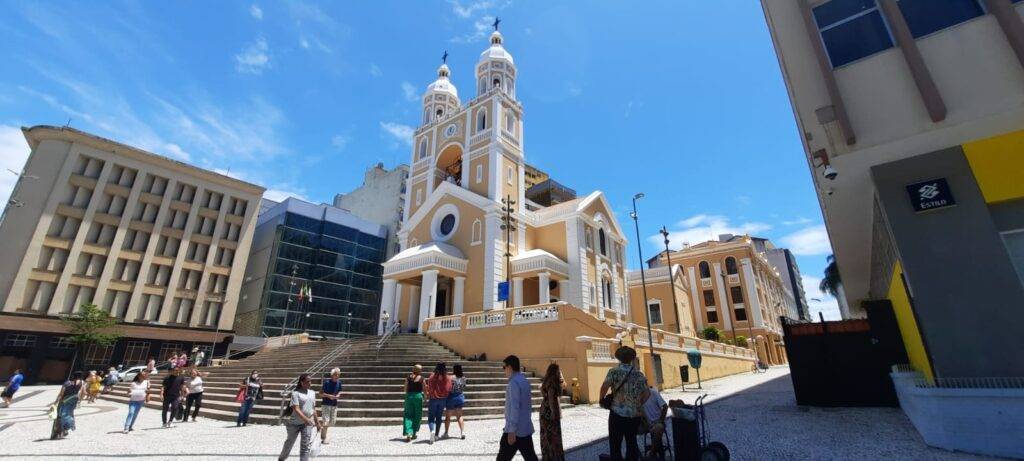
Photo: View of the Cathedral of Our Lady of Destero
Outside, using photographs, visitors can find the differences between then and now, like in a game of spot the difference, while the guide discusses the history of the foundation.
Inside the church, visitors encounter an incredible collection of sacred art, ranging from the original image of Saint Catherine of Alexandria, brought from Austria in 1760, to an organ with over a thousand pipes that came from Germany in the early 1920s.
Along the path between the altars, the guide recounts details of the building's construction, the saints, and points out some remnants of old paintings that might go unnoticed by the most inattentive, but which were intentionally left visible during the last major restoration completed in 2010.
The Church of Our Lady of the Rosary and Saint Benedict
Continuing the walk, a few meters along Tenente Silveira Street, the visitor comes across the famous Rosário Staircase, a landmark of the city that leads to... Church of Our Lady of the Rosary and Saint Benedict of the Black Men, built by one of the oldest brotherhoods on the Island. The Rosary Brotherhood was officially founded by enslaved Africans on Santa Catarina Island in 1750 and served the Black and poor who were forbidden from attending the Cathedral. The church was built by them between 1787 and 1830.

Photo: View of the Rosary Staircase and the Church of Our Lady of the Rosary and Saint Benedict of the Black Men
Unlike the previous one, the Rosário church is surprising for its simplicity and absence of exaggerated aesthetic adornments, typical of Portuguese temples, which is consistent with the conditions under which it was built: slowly, by the hands of slaves who had little money and few hours a day for the work. Its main function at the time, as was common for brotherhoods, was to help its followers. Every year, a lottery was held to buy the freedom of one of the faithful. From the main door, the visitor can compare the current scene from the staircase with the work "View of Desterro" by Victor Meirelles, which shows the old city as it was in 1847, another visual resource brought by the guide.
Maria Gabriela's Atelier
To continue with the artistic context, about an hour and a half after the start of the tour, it's time for a break in... Maria Gabriela's studio, A local artist, with a privileged view of the Metropolitan Cathedral, presents her studio where she holds workshops and paints in watercolors, expressing her love for the island. The paintings, depicting houses, beaches, churches, and fortresses, can be purchased as canvases or as exclusive souvenirs created by the artist. After a relaxing coffee break and informal conversation, it's time to continue the walk towards the last church on the tour.
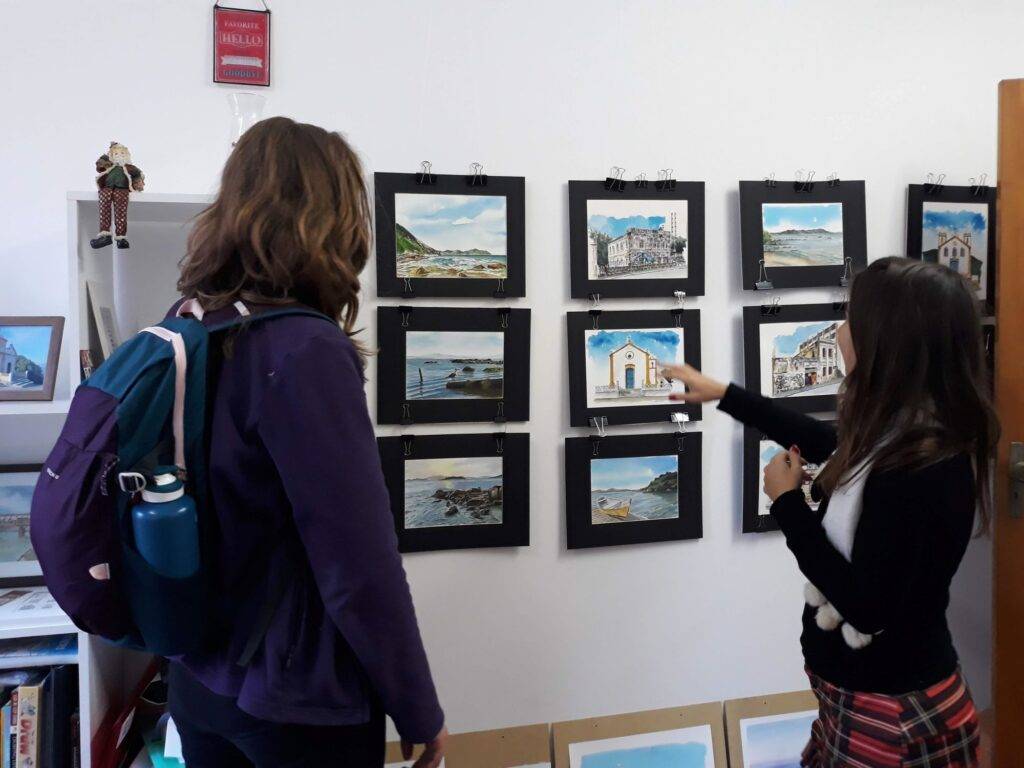
Photo: Visit to Maria Gabriela's studio
Along the way, it's impossible not to admire the ancient Beautiful Olive Garden, today Praça XV de Novembro, the heart of the city center and home to one of the city's greatest treasures, the Centennial Fig Tree. Street art is also present along the route, with particular emphasis on... mural “Black Swan” by the artist Rodrigo Rizo, in homage to the poet João da Cruz e Sousa, in the gardens of Pink Palace, which officially bears the writer's name.
A Church of Saint Francis
Following the Moinhos de Vento promenade, now the iconic Rua Felipe Schmidt, you arrive at Church of Saint Francis of Assisi or Church of the Rooster, with its eclectic architectural style, meaning it has undergone numerous alterations over the years.
The Church of Saint Francis was built by the Third Order of Saint Francis of Penance, which arrived in Desterro in 1745. At that time, the order's meetings took place in the Metropolitan Cathedral, until in 1803 its foundation stone was laid at the address where it is located today. Listed as a Historical Heritage Site of the Municipality and the State of Santa Catarina, it is one of the few churches in Brazil to contain a rare image of Saint Francis at the foot of the Crucified Christ, originating from its inauguration in 1815.
After years of neglect, the Church of Saint Francis underwent a major renovation that also restored 45 original sacred images, including that of Saint Anthony of Categeró, which was brought by slaves who worked on the construction. Today, the church has a room where visitors can see photos of the restoration and some remnants of the wood originally used.

Photo: View of the Church of Saint Francis of Assisi
Approximately 3 hours after the start, the tour heads towards its end in style. happy hour node Public market, where the guide suggests trying a pastel (a type of fried pastry) with sugarcane juice for a truly authentic Florianópolis experience.
This is when the tour ends, and visitors can choose to walk through the shops in the South and North Wings of the Public Market, or continue along the road. Customs Square or stretch the happy hour, which is always a great idea in a city like Florianópolis.
Important notes about the tour:
Due to operating hours and fixed religious events, the tour of the historic churches must be carried out on Mondays, Wednesdays or Fridays and, even then, may be subject to change due to the operating hours of the visited locations, without prior notice.
To schedule the tour, please contact... Carol Floripa Guide via WhatsApp (48) 98481-5112 and for more options, follow Guia Carol on Instagram @guiacarolfloripa